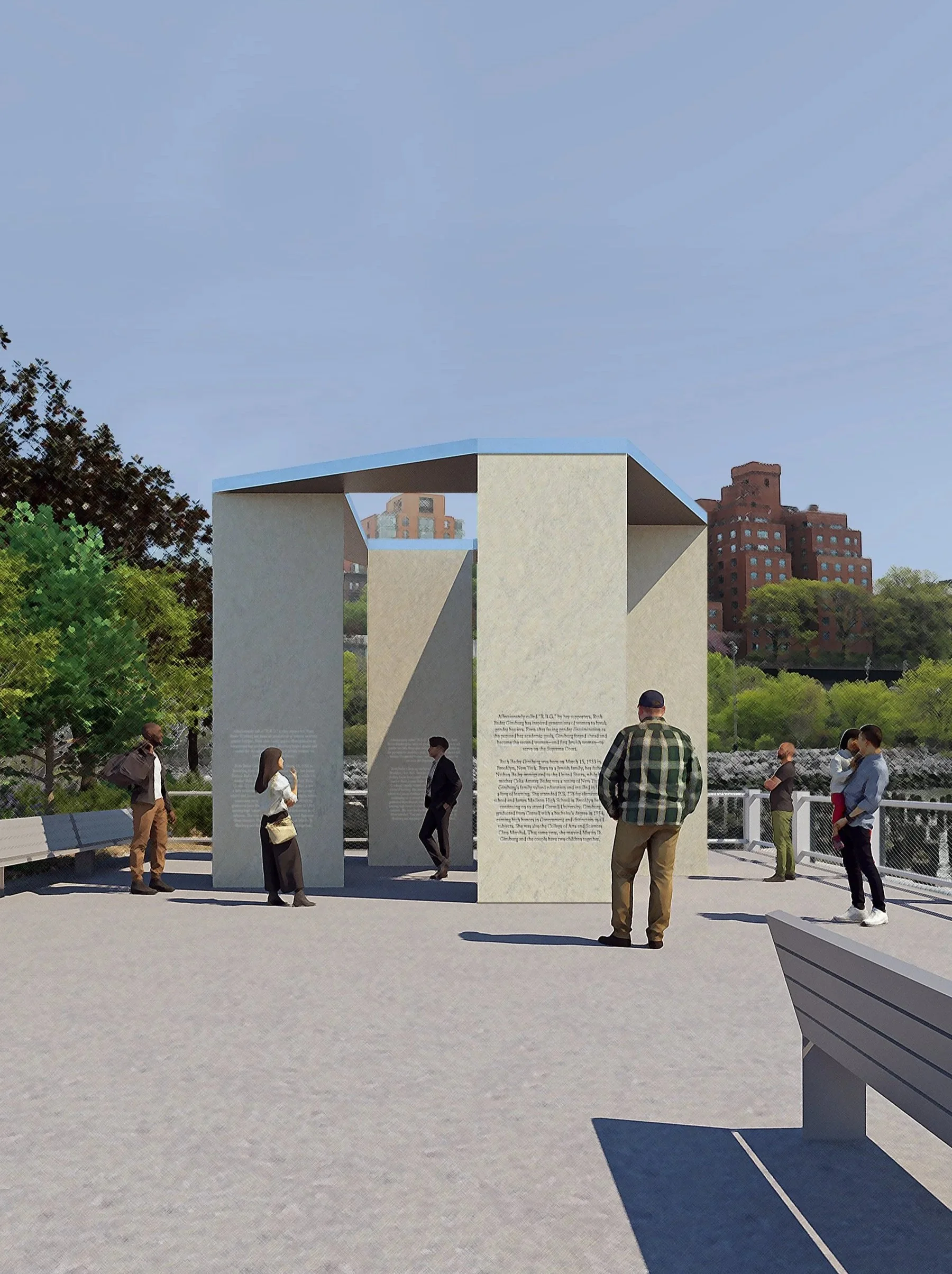
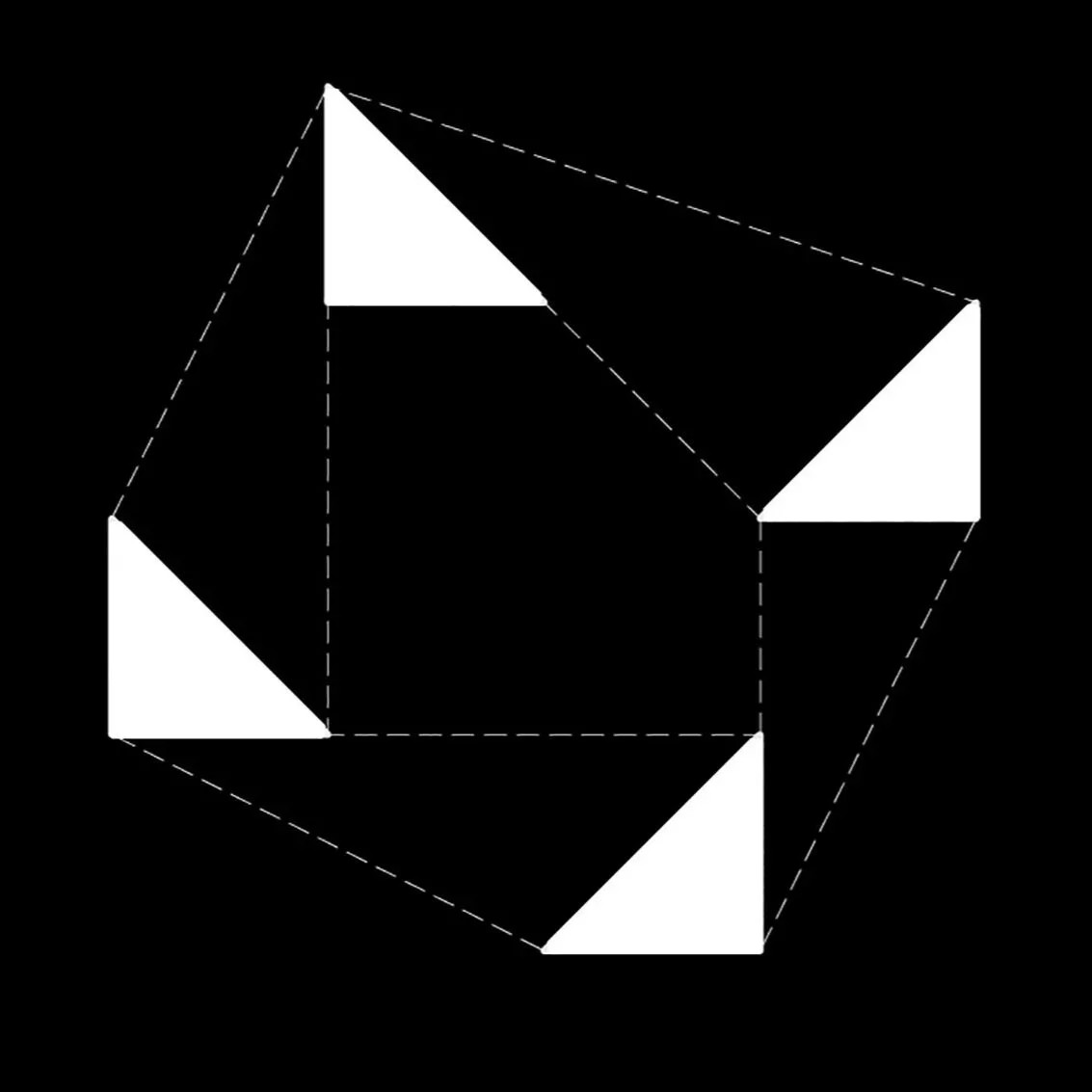
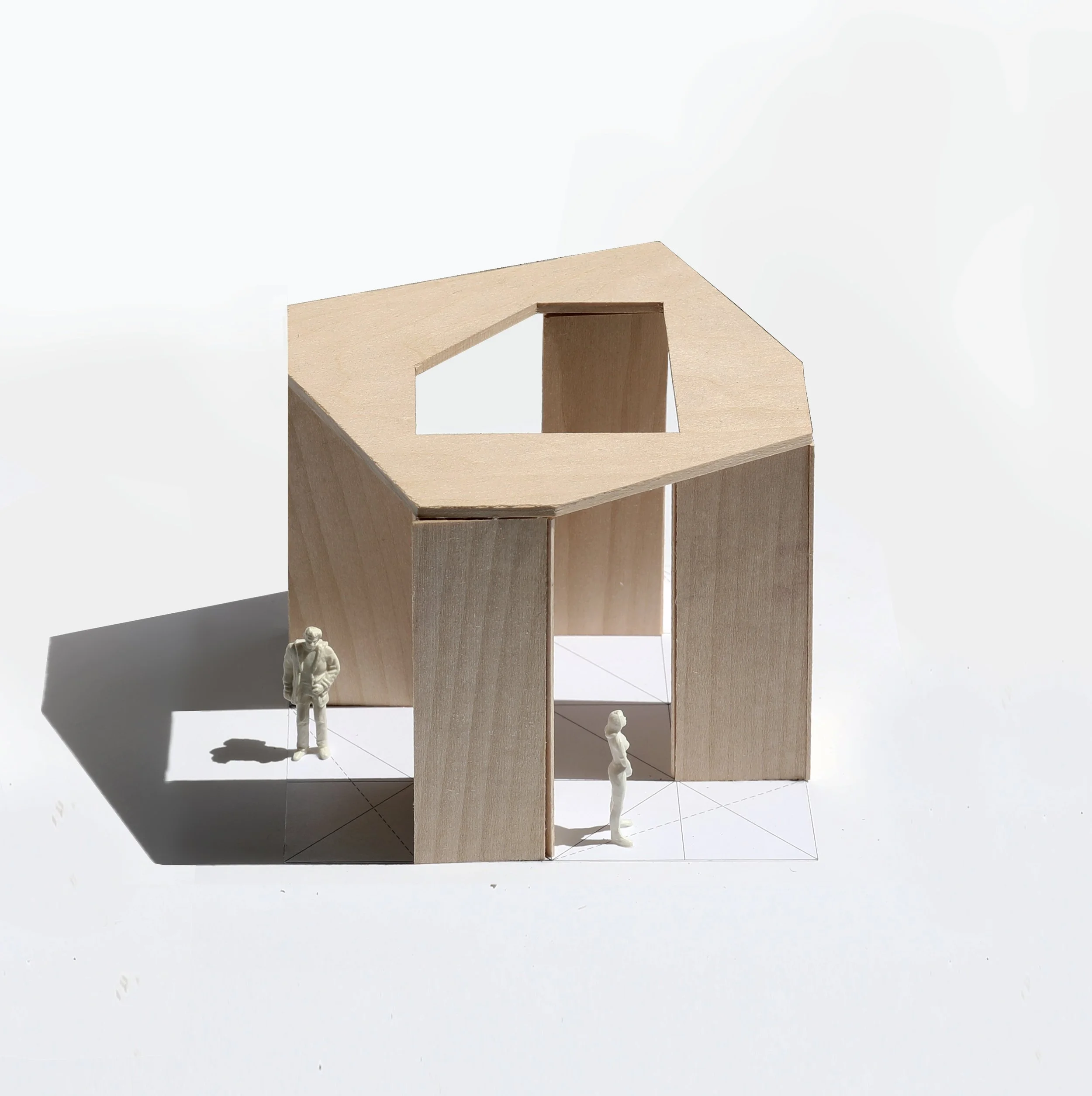
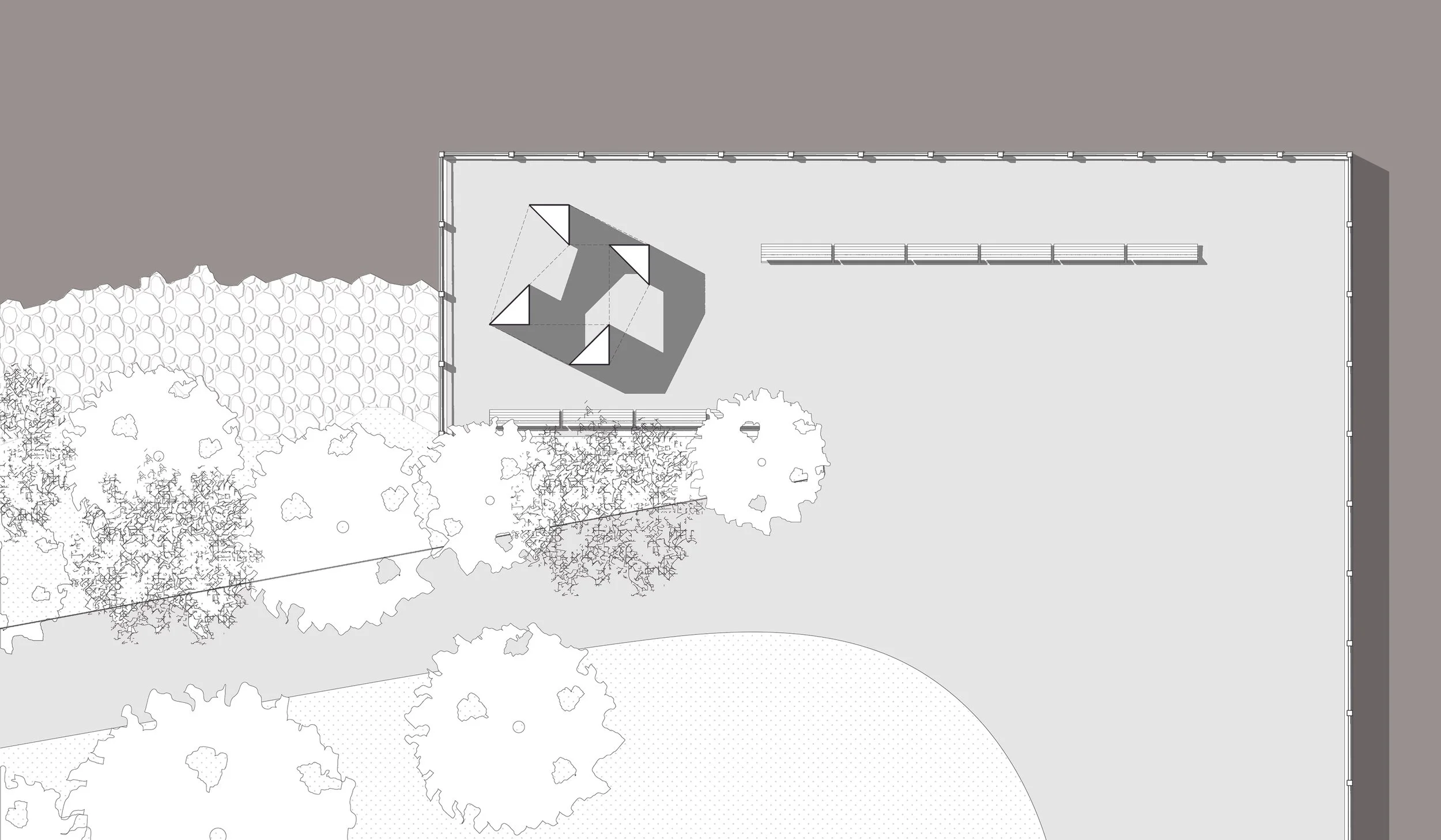
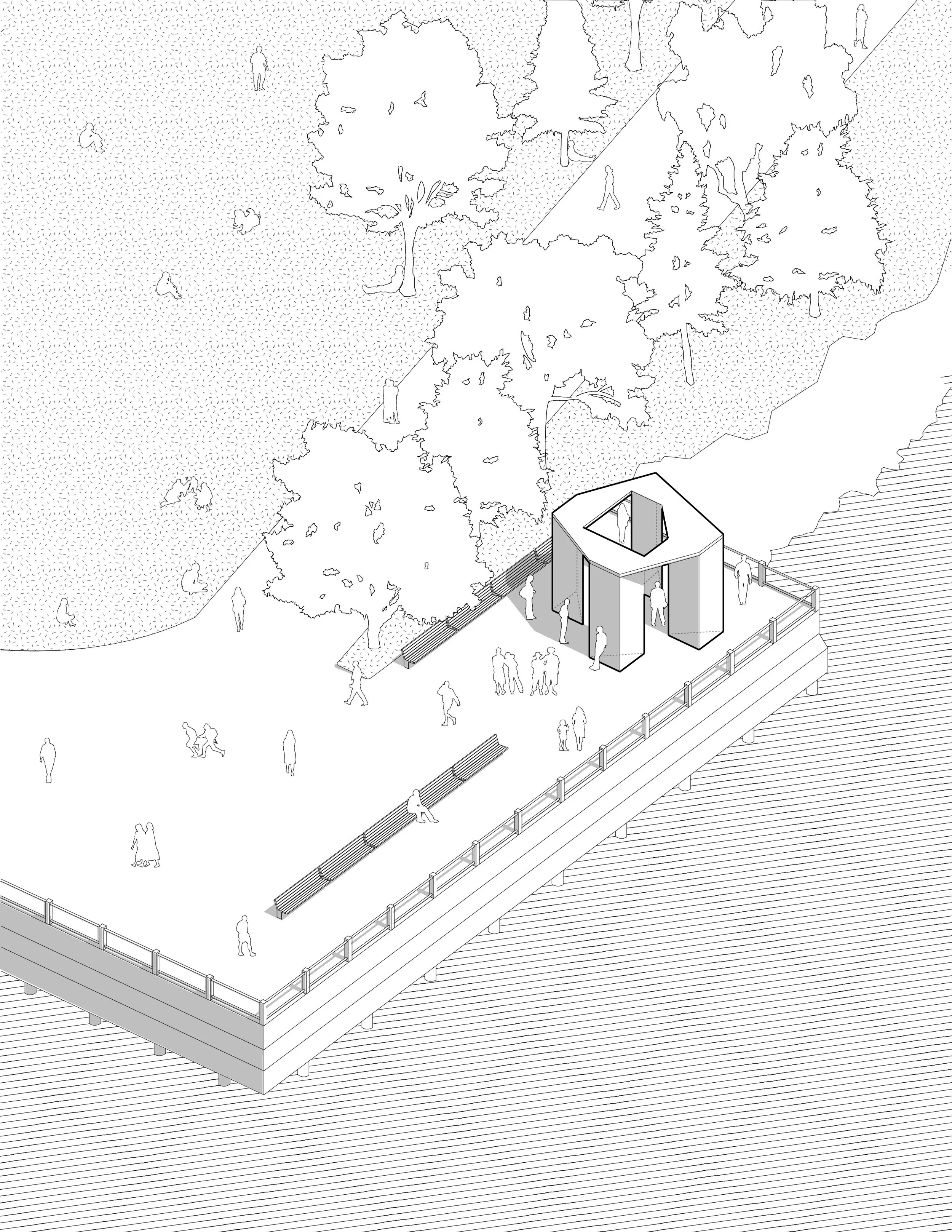
Our proposal for the Ruth Bader Ginsburg Memorial, located on Pier 6 in Brooklyn Bridge Park, is a restrained yet potent composition of geometric elements—four triangular supports and a heptagonal roof—conceived to embody the perseverance and clarity required of a United States Supreme Court Justice. Each column takes the form of a triangle, a fundamental geometry associated with strength and stability, and is articulated through a pairing of stone and polished steel. The steel, set along the hypotenuse, is highly reflective and visible from the north, east, and south, doubling the sky, water, trees, and skyline.
This mirroring operates in two registers. It amplifies the surrounding landscape while simultaneously introducing a subtle instability: shifting reflections fragment perception and suggest a delicate, contingent equilibrium. In this way, the structure gestures toward the inherent precariousness of democratic institutions. The memorial resolves fully only upon arrival at the southwestern edge of Pier 6, where one turns back toward Brooklyn Heights and the promenade above. From this vantage, the mirrored planes recede from view, reducing visual complexity and allowing the composition to be apprehended as a coherent whole.
Eight stone panels—two per column—are inscribed with texts tracing Ruth Bader Ginsburg’s life and legacy: her early years, academic formation, groundbreaking litigation in the 1970s, and tenure on the Supreme Court. Above, a slender steel roof spans dynamically between the supports, offering shelter while maintaining openness. A central skylight draws light and air into the space, concentrating attention inward and upward.
In keeping with Ginsburg’s well-known modesty, the memorial avoids figuration. Rather than depicting her likeness, it advances a conceptual language that reflects the principles she championed. The open structure—without enclosing walls and with a void above—encourages unstructured movement and personal engagement. Visitors may pass through, pause, touch, and reflect without prescribed sequence. At its core, the memorial seeks to evoke the discipline, resolve, and intellectual rigor required to sustain democratic ideals. Its vertical presence also situates it within the broader urban context, contributing a measured landmark to a skyline defined by points of orientation and memory.